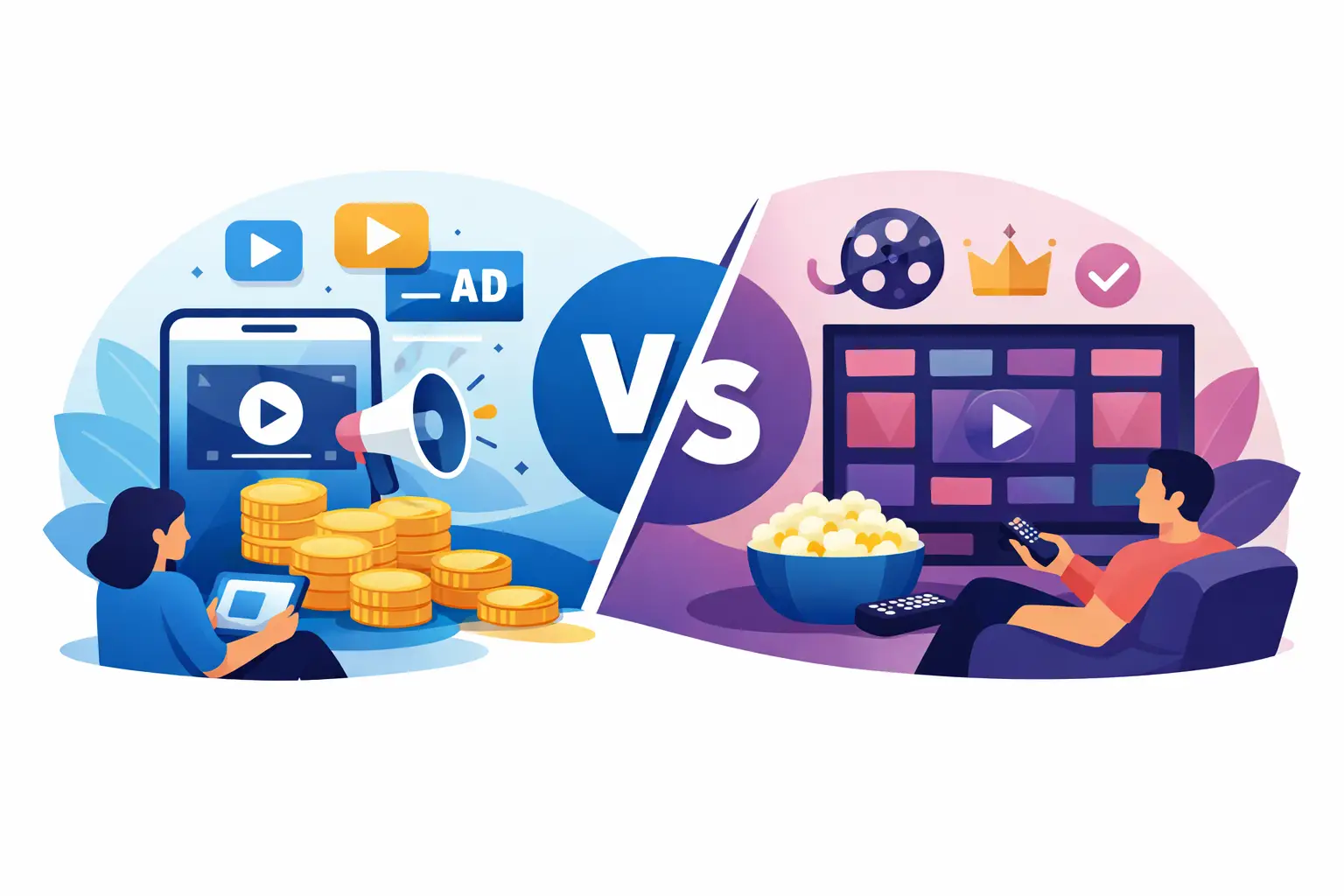
A lot of streaming advice falls apart the second you leave the studio system. If you make indie films, release music videos, or run a niche festival, AVOD vs SVOD streaming is not some abstract media debate. It shapes who finds your work, how fast you get paid, and whether your audience sticks around long enough to care.
For creators and platforms serving independent media, the real question is not which model sounds better on a pitch deck. It is which model actually matches the behavior of your audience, the size of your catalog, and the kind of relationship you want with viewers.
AVOD vs SVOD streaming at a glance
AVOD means advertising-based video on demand. Viewers watch for free, and revenue comes from ads. SVOD means subscription video on demand. Viewers pay a recurring fee for access, usually monthly or annually.
That sounds simple until real-world economics show up. AVOD lowers the barrier to entry because the audience pays with attention instead of cash. SVOD can create steadier recurring revenue, but only if people believe your content is worth another monthly charge on top of everything else they already pay for.
For mainstream platforms with huge marketing budgets and household-name titles, both models can work. For indie media, the trade-offs get sharper. Reach matters more. Discovery matters more. And every bit of friction matters more.
Why AVOD often wins on reach
If your goal is audience growth, AVOD usually gets the first advantage. Free is a strong pitch. A viewer who will hesitate before adding one more subscription will still click play on a free film or music channel if the content looks interesting.
That matters a lot in the indie space, where recognition is earned title by title. Most independent creators do not have built-in global demand. They need a model that helps people sample the work without overthinking the decision.
AVOD also fits how many viewers use connected TV platforms. They browse, test, abandon, return, and channel surf. In that behavior pattern, free content has a clear edge. It is easier to get a first watch when the audience is not being asked to commit before they know your catalog.
The downside is obvious. Ads can interrupt the experience. Revenue per user may be lower than a paid subscriber. And if ad fill rates or CPMs dip, earnings can get unpredictable. Free attracts more viewers, but it does not guarantee deep loyalty.
Where SVOD still makes sense
SVOD works best when the content offers a clear reason to pay every month. That can be exclusivity, a deep library, a strong brand identity, or a community that sees the platform as part of its routine.
For some niches, that equation is solid. If a service consistently delivers premium, hard-to-find content to a highly engaged audience, subscriptions can support a more stable business. You are not waiting for ad inventory to perform. You are asking a committed audience to back access directly.
But this is where many streaming businesses misread the room. A subscription model is not just about putting content behind a paywall. It is about proving ongoing value. One strong indie film is rarely enough. Even ten strong films may not be enough unless viewers see a reason to keep paying next month.
SVOD can also slow discovery. A paywall filters out casual viewers, and casual viewers often become future fans. If your top priority is building awareness for artists, directors, or emerging genres, that filter can cost more than it earns.
AVOD vs SVOD streaming for indie creators
For indie creators, AVOD vs SVOD streaming is really a question of access versus commitment. AVOD gives your work a better shot at being discovered by viewers who were not specifically searching for you. SVOD can put your content in a more premium environment, but often in front of a narrower audience.
If you are early in your career, reach is usually the smarter bet. Exposure is not everything, but obscurity pays even less. A free, ad-supported environment can help a new filmmaker or musician build a real audience without asking strangers to spend money upfront.
If you already have an established following, SVOD becomes more realistic. Fans who trust your output may be willing to subscribe, especially if they get more than just access to a single title. Behind-the-scenes content, event programming, premieres, and a strong release cadence all make the proposition stronger.
That said, creators should be careful with prestige thinking. Paid does not automatically mean better. A premium label means very little if it cuts your visibility in half and stalls momentum.
What viewers actually want
Most viewers do not wake up thinking about business models. They care about convenience, price, and whether the content feels worth their time.
That is why AVOD keeps growing. People are tired of stacking subscriptions. The average household already juggles enough monthly charges. Free streaming with ads feels like a practical trade, especially when the content is niche, experimental, or discovery-driven.
SVOD still appeals when the audience trusts the platform. If viewers know they will regularly find films, series, or music content they cannot get elsewhere, a subscription feels justified. But trust takes time to build, and it is harder for smaller catalogs.
In indie media, many viewers like to explore before they commit. They want proof that your programming matches their taste. AVOD gives them that runway.
Revenue is not just about the model
A lot of comparisons between AVOD and SVOD focus on gross revenue, but that misses the bigger point. The better model depends on scale, retention, and audience behavior.
SVOD can look great on paper because recurring revenue is attractive. But if churn is high, acquisition costs are rising, and the catalog is not sticky enough, the math gets ugly fast. You are constantly fighting to replace subscribers who leave.
AVOD can look weaker per user, yet still outperform in practice when it drives larger viewing volume and broader discovery. More viewers can mean more ad impressions, more data, more repeat traffic, and more opportunities to grow creators over time.
For indie platforms, there is another factor that matters just as much as top-line revenue: payout speed and transparency. Creators care about how earnings are tracked, when royalties arrive, and whether the system respects their margins. A flashy model with slow or opaque payments is not creator-first. It is just good marketing.
The hybrid reality
The smartest streaming businesses increasingly stop treating this as a cage match. They use both models where each one works best.
A hybrid strategy can let a platform use AVOD to widen the top of the funnel and SVOD to monetize deeper engagement. Free content brings in viewers. Premium tiers, events, or special access give superfans a reason to pay.
This is especially useful in the indie world. A viewer might discover a filmmaker through a free ad-supported title, then pay for a festival pass, bonus content, or curated premium programming later. A musician might reach a broad audience through free streaming, then convert fans into direct supporters through other paid experiences.
That approach also respects how independent audiences behave. They want choice. Some will watch ads. Some will pay. Some will do both depending on the content and the moment.
Which model fits your platform?
If your platform is built around discovery, broad access, and emerging talent, AVOD has strong advantages. It reduces friction, supports experimentation, and helps smaller creators reach people who would never cross a paywall for unknown work.
If your platform has a highly loyal niche audience, a constant flow of must-watch programming, and a clear premium identity, SVOD can be powerful. But it demands consistency. You cannot coast on a handful of good releases and expect subscribers to stay.
For many indie-focused services, AVOD is the more natural starting point and hybrid is the stronger long-term play. That is part of why platforms like VersusMedia can serve both sides of the market - giving viewers free access to independent films and music videos while helping creators build distribution, monetization, and real audience traction.
The better question to ask
Instead of asking whether AVOD or SVOD is better, ask what job the model needs to do.
Do you need fast audience growth? Lower friction matters. Do you need recurring revenue from a committed niche? Subscription may fit. Do you need both reach and monetization without cutting off discovery? Build a system that lets free viewing and premium value work together.
The strongest streaming strategy is usually the one that respects the audience you actually have, not the one the biggest players taught everyone to copy. For indie creators and indie fans, that often means keeping access open, making monetization fair, and giving great work more than one path to be seen.