Ryan Vinson
Founder of VersusMedia
There was a time when if you wanted to put something impossible on screen, you had to build it.
Miniatures. Makeup. Animatronics. Optical tricks. Entire departments existed to make the unreal feel real using physical materials and hands-on craftsmanship. Practical effects were not just part of filmmaking, they were filmmaking.
Then computer generated imagery started creeping in.
At first, it was subtle. A small enhancement here. A background extension there. Early CGI was used to support practical effects, not replace them. But as the late 1990s rolled into the 2000s, something changed. Digital workflows matured. Cameras moved away from film. Post-production pipelines became fully digital. And once everything lived inside a computer, it only made sense that more of what we saw on screen would be created there too.
That shift opened the door.
Suddenly, studios could attempt things that were either impossible or wildly expensive with practical effects. Entire environments. Massive destruction sequences. Creatures that would have taken months to build physically could now be generated and adjusted on the fly.
Then it trickled down.
What started as a big studio advantage became accessible to independent filmmakers. Software got cheaper. Hardware got faster. A small team could now attempt visual effects that would have required an entire department a decade earlier. Not all of it looked great, but that was never really the point. The barrier had been lowered. Filmmakers could tell bigger stories with fewer resources.
I still prefer practical effects in a lot of cases. There is a weight to them. A presence that is hard to replicate. When CGI is overused, I notice it. It pulls me out of the experience. You can feel when something is not grounded.
But at the same time, it is impossible to ignore how useful CGI has become. There are things you simply cannot do any other way. The issue has never been the tool. It is how heavily a film leans on it.
That transition also reshaped the workforce.
Some roles became less in demand. Others appeared almost overnight. Instead of large teams building physical models, you had artists working inside 3D software. You needed engineers, pipeline developers, render specialists. Entire new career paths were created because of that shift.
And there was backlash.
There were strong opinions that CGI was ruining film. That it lacked soul. That it made everything feel artificial. Fully digital characters were often criticized and rejected by audiences early on.
Now look where we are.
Many of the biggest films in the world rely heavily on CGI. Entire franchises are built around it. Audiences have largely accepted it, even if they still call out when it is done poorly.
Technology moved forward, and film moved with it.
Which brings us to where we are now.
AI.
It feels familiar.
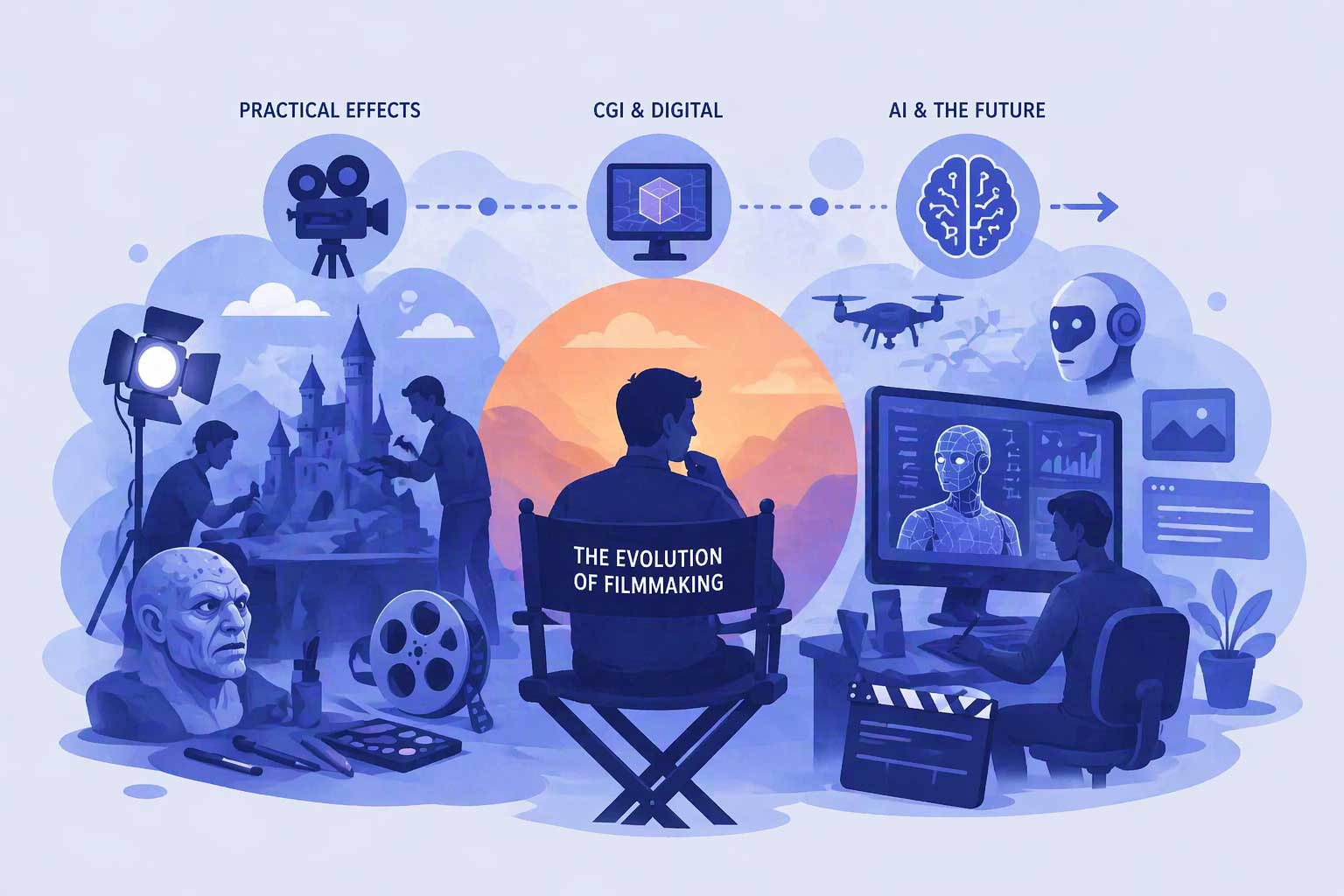
For decades, practical effects led the way, with digital tools assisting. Then CGI became dominant, with practical effects filling in where needed. Now CGI sits at the top, practical effects are used more selectively, and AI has entered the picture.
The question is whether this follows the same pattern.
It took a long time for CGI to reach its current position. Nearly a century of filmmaking evolved before it became the default approach for many productions. AI is moving at a completely different speed. What used to take years now happens in months.
That alone changes the conversation.
There is already speculation about what this means for jobs. Will traditional CGI roles shrink? Will studios build internal AI teams focused on model training, prompt workflows, and custom pipelines? Will smaller teams be able to do what once required entire departments?
We have seen this before, just in a different form.
As CGI lowered the barrier for visual effects, AI is lowering the barrier across the entire pre-production and creative planning process. That is a big part of why I built FilmPilot.ai. The idea is simple. If someone has a script, they should be able to turn that into something tangible without needing a full studio behind them.
Storyboards. Character concepts. Budget estimates. A rough sense of how the film might come together. These used to take time, money, and a team. Now they can be generated quickly, giving independent filmmakers a way to move forward instead of getting stuck.
That does not mean AI replaces the creative process. It supports it.
Still, the resistance is real.
There is a strong pushback against AI in film right now. Concerns about originality. Concerns about jobs. Concerns about what happens when too much of the process becomes automated. And I get it. I wish there was a middle ground somewhere. It's affecting myself and my own technical experiences as well.
And that part does feel similar to the early days of CGI.
But this is where the comparison starts to break.
CGI was a tool that still required specialists to operate at a high level. It enhanced human effort. AI, in many cases, reduces the amount of effort needed to get started. It compresses the early stages of creation in a way we have not really seen before.
That is a different kind of shift.
It is not just about how something looks on screen. It changes how projects get off the ground in the first place. Who gets to participate. How quickly ideas move from concept to execution.
There are also deeper questions around ownership, training data, and creative control that did not exist in the same way during the rise of CGI. Those conversations are not going away anytime soon.
So while there are clear parallels, this is not a one to one repeat of history.
CGI could not be stopped, and neither will AI.
The difference is how fast it is happening, and how many parts of the process it touches beyond just the final image.
We are likely at the beginning of another shift. What it looks like in five or ten years is still unclear.
Some people will lean into it. Some will avoid it. Most will probably land somewhere in the middle, using it where it makes sense and ignoring it where it does not.
That is usually how these things settle.
The tools change. The conversations repeat. The industry adapts.
What matters is what filmmakers choose to do with it.
So where do you land on it?